Geometry Primitives
Overlap depth and direction
This chapter adds geometry tests for boxes, circles and segments. The shapes lab moves a probe with the arrow keys and draws each overlap answer as an arrow.
An overlap test answers two questions. First, do the shapes overlap? If they do, how far and in which unit direction should the first shape move to separate them? Edges that only touch do not count as overlap.
Shape tests
Two boxes, one from (0, 0) to (10, 10) and one from (7, 3) to (20, 20). They are apart if the first ends before the second starts along x, or the second before the first, or the same along y: four comparisons, and if none of them says apart the boxes overlap. Here none does. How deep is the smallest of the four overlaps: the first's right edge is 3 past the second's left edge, the second's right is 13 past the first's left, and along y the two overlaps are 7 and 17. The smallest is 3, along x, so the depth is 3 and the push is a unit step away from the second box along that axis, (−1, 0). Two boxes from 0 to 10 and from 10 to 20 share an edge and do not overlap, because the comparison is "ends at or before", so a resting box is not pushed.
Two circles of radius 5 whose centres are 8 apart overlap by 2: the radii reach 10 and the centres are 8 apart. The test compares the squared distance between the centres, 64, with the square of the reach, 100, and takes a square root only when the squares say there is an overlap to measure, so a pair of circles that are nowhere near each other costs a subtraction, two multiplications and a comparison. Two circles 10 apart touch and do not overlap. The push is the unit direction from the second centre to the first, and two circles on one centre have no direction between them, so the test picks x.
A circle against a box is a circle against one point: the point of the box nearest the circle's centre, which is the centre with each coordinate held into the box's range. A circle of radius 5 centred at (12, 5) against the first box has its nearest point at (10, 5), 2 away, so it overlaps by 3 and is pushed along (1, 0). A centre inside the box is its own nearest point, with no direction to it, and then the push is out through the nearest face by the radius plus the distance to that face.
Two segments meet or do not, and the tool is the cross product of two vectors, a.x · b.y − a.y · b.x, one number whose sign says which side of a the vector b is on and whose size is the area of the parallelogram they span. For a segment from A to B with d = B − A and another from C to D with e = D − C, the point A + t·d is on the second line when (C − A) × e = t · (d × e), and C + u·e is on the first when (C − A) × d = u · (d × e); the segments cross when both t and u are between 0 and 1. For (0, 0)–(10, 10) against (0, 10)–(10, 0): d = (10, 10), e = (10, −10), C − A = (0, 10), d × e = −100 − 100 = −200, (C − A) × e = 0 − 100 = −100, so t = 0.5, and (C − A) × d = 0 − 100 = −100, so u = 0.5: they cross at A + 0.5d = (5, 5). A d × e of zero means the lines are parallel, and then a zero (C − A) × d means they are the same line; the test names both cases instead of dividing by the zero.
// internal/vec/shapes.go — create
package vec

import "math"

// Cross is the two-dimensional cross product, a.X·b.Y − a.Y·b.X: the
// signed area of the parallelogram the two vectors span. It is zero when
// they are parallel, and its sign says which side of a the vector b is on.
func (a Vec2) Cross(b Vec2) float64 {
	return a.X*b.Y - a.Y*b.X
}

// AABB is an axis-aligned box: its least corner and its greatest.
type AABB struct {
	Min, Max Vec2
}

// Circle is a centre and a radius.
type Circle struct {
	Centre Vec2
	R      float64
}

// Segment is the straight piece between two points.
type Segment struct {
	A, B Vec2
}

// Hit is what an overlap test reports when two shapes overlap: how far the
// first reaches into the second along the shortest way out, and that way,
// a unit vector pointing from the second toward the first, which is the
// direction to push the first to separate them.
type Hit struct {
	Depth  float64
	Normal Vec2
}

// OverlapAABB tests two boxes: four comparisons, and boxes that only touch
// along an edge do not overlap. The depth is the smallest of the four
// overlaps and the normal is along that axis, away from b.
func OverlapAABB(a, b AABB) (Hit, bool) {
	if a.Max.X <= b.Min.X || b.Max.X <= a.Min.X || a.Max.Y <= b.Min.Y || b.Max.Y <= a.Min.Y {
		return Hit{}, false
	}
	// The four overlaps: how far a's right edge is past b's left, and so on.
	left, right := a.Max.X-b.Min.X, b.Max.X-a.Min.X
	top, bottom := a.Max.Y-b.Min.Y, b.Max.Y-a.Min.Y
	h := Hit{Depth: left, Normal: Vec2{X: -1}}
	if right < h.Depth {
		h = Hit{Depth: right, Normal: Vec2{X: 1}}
	}
	if top < h.Depth {
		h = Hit{Depth: top, Normal: Vec2{Y: -1}}
	}
	if bottom < h.Depth {
		h = Hit{Depth: bottom, Normal: Vec2{Y: 1}}
	}
	return h, true
}

// OverlapCircles tests two circles by comparing the squared distance
// between their centres with the square of the radii's sum, so that no
// square root is taken unless they do overlap. Circles that only touch do
// not overlap. Two circles on one centre have no direction between them,
// and the normal is taken along x.
func OverlapCircles(a, b Circle) (Hit, bool) {
	d := a.Centre.Sub(b.Centre)
	reach := a.R + b.R
	d2 := d.Dot(d)
	if d2 >= reach*reach {
		return Hit{}, false
	}
	if d2 == 0 {
		return Hit{Depth: reach, Normal: Vec2{X: 1}}, true
	}
	dist := math.Sqrt(d2)
	return Hit{Depth: reach - dist, Normal: d.Scale(1 / dist)}, true
}

// Closest is the point of the box nearest to p: p itself when p is inside,
// otherwise p with each coordinate held to the box's range.
func (b AABB) Closest(p Vec2) Vec2 {
	return Vec2{
		X: math.Max(b.Min.X, math.Min(p.X, b.Max.X)),
		Y: math.Max(b.Min.Y, math.Min(p.Y, b.Max.Y)),
	}
}

// OverlapCircleAABB tests a circle against a box: the circle overlaps the
// box exactly when it overlaps the point of the box nearest its centre.
// When the centre is inside the box the nearest point is the centre and
// there is no direction to it, so the push is out through the nearest
// face, by the radius plus the distance to that face.
func OverlapCircleAABB(c Circle, b AABB) (Hit, bool) {
	p := b.Closest(c.Centre)
	if p == c.Centre {
		toLeft, toRight := c.Centre.X-b.Min.X, b.Max.X-c.Centre.X
		toTop, toBottom := c.Centre.Y-b.Min.Y, b.Max.Y-c.Centre.Y
		h := Hit{Depth: c.R + toLeft, Normal: Vec2{X: -1}}
		if toRight < toLeft && toRight <= toTop && toRight <= toBottom {
			h = Hit{Depth: c.R + toRight, Normal: Vec2{X: 1}}
		} else if toTop < toLeft && toTop <= toBottom {
			h = Hit{Depth: c.R + toTop, Normal: Vec2{Y: -1}}
		} else if toBottom < toLeft {
			h = Hit{Depth: c.R + toBottom, Normal: Vec2{Y: 1}}
		}
		return h, true
	}
	return OverlapCircles(c, Circle{Centre: p})
}

// Meet says how two segments lie: they cross at one point, they are
// parallel and apart, they lie on one line, or their lines cross somewhere
// off one segment or both.
type Meet uint8

const (
	Apart Meet = iota
	Crossing
	Parallel
	Collinear
)

// String names the way two segments meet.
func (m Meet) String() string {
	return [...]string{"apart", "crossing", "parallel", "collinear"}[m]
}

// Intersect finds where two segments cross. With d = B − A and e = D − C,
// the point A + t·d is on the second line when (C − A) × e = t·(d × e), and
// C + u·e is on the first when (C − A) × d = u·(d × e); the segments cross
// when both t and u are within [0, 1]. A zero d × e means the lines are
// parallel, and then a zero (C − A) × d means they are the same line.
func Intersect(s, o Segment) (Vec2, Meet) {
	d, e := s.B.Sub(s.A), o.B.Sub(o.A)
	ca := o.A.Sub(s.A)
	denom := d.Cross(e)
	if denom == 0 {
		if ca.Cross(d) == 0 {
			return Vec2{}, Collinear
		}
		return Vec2{}, Parallel
	}
	t := ca.Cross(e) / denom
	u := ca.Cross(d) / denom
	if t < 0 || t > 1 || u < 0 || u > 1 {
		return Vec2{}, Apart
	}
	return s.A.Add(d.Scale(t)), Crossing
}
go vet ./...
Each overlap test returns a Hit and a boolean. The boolean says
whether the shapes overlap. The Hit only matters when the boolean is
true.
OverlapAABB uses <= when it checks for separation, so
touching boxes do not overlap. OverlapCircles uses the matching
>= rule for touching rims.
OverlapCircleAABB reduces the box test to the nearest point on the box.
Intersect checks for a zero cross product before it divides, so
parallel and collinear segments get named instead of crashing the formula.
Moving the probe
Extend cmd/motion with the shapes lab. It keeps three fixed shapes: a
box, a circle and a segment. The probe is one point under the arrow keys.
Each tick, the lab builds three probe shapes from that point: a circle, its bounding box and a segment. It runs four tests, draws each push as a gold arrow and draws a segment crossing as a gold cross. Space prints the depths and directions.
// cmd/motion/shapes.go — create
package main

import (
	"fmt"

	"github.com/hajimehoshi/ebiten/v2"
	"github.com/hajimehoshi/ebiten/v2/vector"

	"gez/internal/vec"
)

// The shapes lab keeps three fixed things, a box, a circle and a segment,
// and a probe under the arrow keys: a circle, the box that bounds it, and
// a segment from its centre. Every tick it runs the four overlap tests
// between probe and fixture and draws what each reports.
const probeR = 12.0

var (
	fixedBox     = vec.AABB{Min: vec.Vec2{X: 40, Y: 60}, Max: vec.Vec2{X: 120, Y: 120}}
	fixedCircle  = vec.Circle{Centre: vec.Vec2{X: 220, Y: 90}, R: 28}
	fixedSegment = vec.Segment{A: vec.Vec2{X: 130, Y: 160}, B: vec.Vec2{X: 300, Y: 40}}
	probeStart   = vec.Vec2{X: 160, Y: 100}
	probeArm     = vec.Vec2{X: 30, Y: -50} // the probe's segment, from its centre
)

// shapesLab keeps the probe's centre and nothing else; the probe's three
// shapes are built from it on every tick.
type shapesLab struct {
	probe vec.Vec2
}

func newShapesLab() *shapesLab {
	return &shapesLab{probe: probeStart}
}

// step moves the probe a pixel a tick. Space prints the four tests.
func (l *shapesLab) step(k keys) {
	var d vec.Vec2
	if k.left {
		d.X--
	}
	if k.right {
		d.X++
	}
	if k.up {
		d.Y--
	}
	if k.down {
		d.Y++
	}
	l.probe = l.probe.Add(d)
	if k.space {
		bb, cc, cb, okB, okC, okCB, cross, meet := l.hits()
		fmt.Printf("probe %v: box %s  circle %s  circle-box %s\n", l.probe, hitText(bb, okB), hitText(cc, okC), hitText(cb, okCB))
		if meet == vec.Crossing {
			fmt.Printf("segments %v at %v\n", meet, cross)
		} else {
			fmt.Printf("segments %v\n", meet)
		}
	}
}

// The probe's three shapes.
func (l *shapesLab) circle() vec.Circle {
	return vec.Circle{Centre: l.probe, R: probeR}
}

func (l *shapesLab) box() vec.AABB {
	r := vec.Vec2{X: probeR, Y: probeR}
	return vec.AABB{Min: l.probe.Sub(r), Max: l.probe.Add(r)}
}

func (l *shapesLab) segment() vec.Segment {
	return vec.Segment{A: l.probe, B: l.probe.Add(probeArm)}
}

// hits runs the four tests: probe box against the fixed box, probe circle
// against the fixed circle, probe circle against the fixed box, and probe
// segment against the fixed segment.
func (l *shapesLab) hits() (bb, cc, cb vec.Hit, okB, okC, okCB bool, cross vec.Vec2, meet vec.Meet) {
	bb, okB = vec.OverlapAABB(l.box(), fixedBox)
	cc, okC = vec.OverlapCircles(l.circle(), fixedCircle)
	cb, okCB = vec.OverlapCircleAABB(l.circle(), fixedBox)
	cross, meet = vec.Intersect(l.segment(), fixedSegment)
	return
}

// hitText is a hit as the printed line shows it: the depth and the way
// out, or a dash for no overlap.
func hitText(h vec.Hit, ok bool) string {
	if !ok {
		return "-"
	}
	return fmt.Sprintf("%.4f %v", h.Depth, h.Normal)
}

// depthText is a hit as the HUD shows it: the depth alone, since the
// picture draws the way out.
func depthText(h vec.Hit, ok bool) string {
	if !ok {
		return "-"
	}
	return fmt.Sprintf("%.4f", h.Depth)
}

func (l *shapesLab) draw(screen *ebiten.Image, h *hud) {
	bb, cc, cb, okB, okC, okCB, cross, meet := l.hits()
	// The fixtures, dim.
	vector.StrokeRect(screen, float32(fixedBox.Min.X), float32(fixedBox.Min.Y), float32(fixedBox.Max.X-fixedBox.Min.X), float32(fixedBox.Max.Y-fixedBox.Min.Y), 1, dimColor, false)
	vector.StrokeCircle(screen, float32(fixedCircle.Centre.X), float32(fixedCircle.Centre.Y), float32(fixedCircle.R), 1, dimColor, false)
	vector.StrokeLine(screen, float32(fixedSegment.A.X), float32(fixedSegment.A.Y), float32(fixedSegment.B.X), float32(fixedSegment.B.Y), 1, dimColor, false)
	// The probe, lit.
	b, s := l.box(), l.segment()
	vector.StrokeRect(screen, float32(b.Min.X), float32(b.Min.Y), float32(2*probeR), float32(2*probeR), 1, xColor, false)
	vector.StrokeCircle(screen, float32(l.probe.X), float32(l.probe.Y), probeR, 1, lineColor, false)
	vector.StrokeLine(screen, float32(s.A.X), float32(s.A.Y), float32(s.B.X), float32(s.B.Y), 1, lineColor, false)
	// What the tests found: each push drawn from the probe's centre, the
	// crossing as a small cross.
	for _, hit := range []struct {
		hit vec.Hit
		ok  bool
	}{{bb, okB}, {cc, okC}, {cb, okCB}} {
		if hit.ok {
			arrow(screen, h, l.probe, hit.hit.Normal.Scale(hit.hit.Depth), yColor, "")
		}
	}
	if meet == vec.Crossing {
		vector.StrokeLine(screen, float32(cross.X-3), float32(cross.Y-3), float32(cross.X+3), float32(cross.Y+3), 1, yColor, false)
		vector.StrokeLine(screen, float32(cross.X-3), float32(cross.Y+3), float32(cross.X+3), float32(cross.Y-3), 1, yColor, false)
	}
}

func (l *shapesLab) lines() (top, bottom string) {
	bb, cc, cb, okB, okC, okCB, _, meet := l.hits()
	return fmt.Sprintf("probe %v  box %s  circle %s", l.probe, depthText(bb, okB), depthText(cc, okC)),
		fmt.Sprintf("circle-box %s  segments %v", depthText(cb, okCB), meet)
}
// cmd/motion/main.go — extend
// newLab builds the lab named, from the seed: the one place a name
// becomes a lab. Labs that draw no random numbers ignore the seed.
func newLab(name string, seed uint64) (lab, error) {
switch name {
case "circle":
return newCircleLab(), nil
case "arrows":
return newArrowsLab(), nil
case "ship":
return newShipLab(), nil
case "ball":
return newBallLab(), nil
case "ease":
return newEaseLab(), nil
case "dots":
return newDotsLab(seed), nil
case "shapes":
return newShapesLab(), nil
}
return nil, fmt.Errorf("no lab called %q", name)
}go vet ./...
go run ./cmd/motion -lab shapes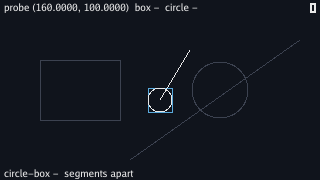
Press Space where the probe starts, hold Left for fifty ticks and press it again, hold Right for eighty and press it again, then Down for forty and once more:
$ go run ./cmd/motion -lab shapes
probe (160.0000, 100.0000): box -  circle -  circle-box -
segments apart
probe (110.0000, 100.0000): box 22.0000 (1.0000, 0.0000)  circle -  circle-box 22.0000 (1.0000, 0.0000)
segments apart
probe (190.0000, 100.0000): box -  circle 8.3772 (-0.9487, 0.3162)  circle-box -
segments apart
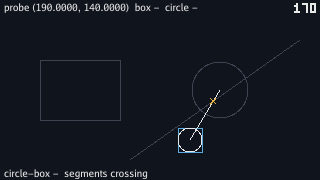
probe (190.0000, 140.0000): box -  circle -  circle-box -
segments crossing at (213.2653, 101.2245)
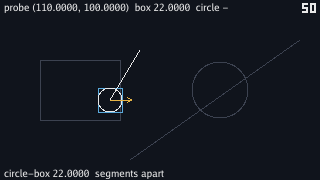
At (110, 100), the probe's box runs from x = 98 to x = 122. The fixed box ends at x = 120. The four overlaps are 82, 22, 52 and 32. The smallest is 22, so the push goes right along (1, 0).
The circle-against-box test agrees by a different route. The centre is inside the box, ten pixels from the right face, and ten plus the radius of twelve gives 22. The fixed circle is too far away, and the probe segment misses the fixed segment.
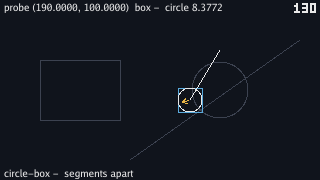
At (190, 100), the centres are (−30, 10) apart. The squared distance is 1000, and the squared reach is 1600, so the circles overlap. The distance is 31.6228, and the depth is 40 − 31.6228 = 8.3772.
The normal is (−30, 10) normalised, or (−0.9487, 0.3162). Forty ticks of Down moves the probe segment across the fixed segment, and the lab marks the crossing at (213.27, 101.22).
The lab stores one point and builds three shapes from it every tick, so the probe
shapes can't disagree about their centre. hits runs all four tests.
draw and lines both call it, so the picture and HUD use
the same answers.
A rectangle can be stored as a corner plus size or as two corners. The package
stores AABB as two corners because the overlap tests need its edges.
Ebitengine provides image.Rectangle for sub-images, but it doesn't
provide the collision geometry here. The overlap tests are the reader's arithmetic.
Measuring square roots
Add a startup measurement to the shapes lab. It scatters 10, 100 and 1000 circles of radius 5 from seed 1. Then it tests every pair and prints how many pairs overlap and how many square roots the circle test takes.
The normal circle test compares squared distances first. The -sqrt flag
runs the slower-looking version that takes the square root on every pair.
// cmd/motion/shapes.go — extend
import (
	"flag"
	"fmt"
	"math"

	"github.com/hajimehoshi/ebiten/v2"
	"github.com/hajimehoshi/ebiten/v2/vector"

	"gez/internal/vec"
)

// newShapesLab prints how many square roots the circle test takes for a
// field of circles, with the package's test and with one that takes the
// root on every pair.
func newShapesLab() *shapesLab {
	for _, n := range []int{10, 100, 1000} {
		s := vec.NewSource(1)
		cs := make([]vec.Circle, n)
		for i := range cs {
			cs[i] = vec.Circle{Centre: vec.Vec2{X: s.Uniform(0, screenW), Y: s.Uniform(14, screenH-14)}, R: 5}
		}
		pairs, overlaps := 0, 0
		for i := range cs {
			for j := i + 1; j < n; j++ {
				pairs++
				if _, ok := circles(cs[i], cs[j]); ok {
					overlaps++
				}
			}
		}
		roots := overlaps
		if *sqrtEvery {
			roots = pairs
		}
		fmt.Printf("%4d circles of radius 5: %6d pairs a tick, %4d overlapping; square roots a tick %6d, a second %8d\n", n, pairs, overlaps, roots, roots*60)
	}
	return &shapesLab{probe: probeStart}
}

// circles is the circle test the lab uses: the package's, or, under -sqrt,
// one that takes the square root of the distance on every test before
// comparing, which is the cost this chapter measures.
func circles(a, b vec.Circle) (vec.Hit, bool) {
	if !*sqrtEvery {
		return vec.OverlapCircles(a, b)
	}
	d := a.Centre.Sub(b.Centre)
	dist := math.Sqrt(d.Dot(d))
	if dist >= a.R+b.R {
		return vec.Hit{}, false
	}
	if dist == 0 {
		return vec.Hit{Depth: a.R + b.R, Normal: vec.Vec2{X: 1}}, true
	}
	return vec.Hit{Depth: a.R + b.R - dist, Normal: d.Scale(1 / dist)}, true
}

// hits runs the four tests: probe box against the fixed box, probe circle
// against the fixed circle, probe circle against the fixed box, and probe
// segment against the fixed segment.
func (l *shapesLab) hits() (bb, cc, cb vec.Hit, okB, okC, okCB bool, cross vec.Vec2, meet vec.Meet) {
	bb, okB = vec.OverlapAABB(l.box(), fixedBox)
	cc, okC = circles(l.circle(), fixedCircle)
	cb, okCB = vec.OverlapCircleAABB(l.circle(), fixedBox)
	cross, meet = vec.Intersect(l.segment(), fixedSegment)
	return
}

var sqrtEvery = flag.Bool("sqrt", false, "take the square root on every circle test instead of comparing squares: the cost this chapter measures, kept so it can be run")
go vet ./...
go run ./cmd/motion -lab shapes$ go run ./cmd/motion -lab shapes
10 circles of radius 5: 45 pairs a tick, 0 overlapping; square roots a tick 0, a second 0
100 circles of radius 5: 4950 pairs a tick, 33 overlapping; square roots a tick 33, a second 1980
1000 circles of radius 5: 499500 pairs a tick, 3084 overlapping; square roots a tick 3084, a second 185040
A thousand circles make 499,500 pairs. In this field, 3,084 pairs overlap. The package test takes 3,084 square roots, one for each overlap, and none for the other 496,416 pairs.
The number of pairs is n(n − 1)/2. Real collision systems avoid testing every pair when they can. This lab tests every pair so the square-root count stays visible.
Run the lab with -sqrt:
$ go run ./cmd/motion -lab shapes -sqrt
  10 circles of radius 5:     45 pairs a tick,    0 overlapping; square roots a tick     45, a second     2700
 100 circles of radius 5:   4950 pairs a tick,   33 overlapping; square roots a tick   4950, a second   297000
1000 circles of radius 5: 499500 pairs a tick, 3084 overlapping; square roots a tick 499500, a second 29970000
The overlaps are the same, 3,084, because the two tests agree on every pair; the roots are 499,500 a tick, thirty million a second, a hundred and sixty times as many. That is the count, and it was the reason the squared comparison was written. The cost in time is a measurement and it was made once, on the machine that made this page's pictures, by timing every pair of the thousand-circle field through both tests, three times each; a time is the machine's and yours will differ:
$ go test ./cmd/motion -run XXX -bench Ch17 -benchtime=2s -count=3
BenchmarkCh17Squares-16    	    1222	   1916150 ns/op
BenchmarkCh17Squares-16    	    1228	   1917830 ns/op
BenchmarkCh17Squares-16    	    1226	   1866577 ns/op
BenchmarkCh17Sqrt-16       	    1280	   1822749 ns/op
BenchmarkCh17Sqrt-16       	    1317	   1918062 ns/op
BenchmarkCh17Sqrt-16       	    1047	   2278212 ns/op
The timing doesn't match the simple count. The squared comparison takes about 1.9 milliseconds for all 499,500 pairs. The root-on-every-pair test ranges from 1.8 to 2.3 milliseconds. On this machine, the extra square roots don't stand apart from the rest of the loop.
The count still matters. The squared test does the work the geometry needs and no more. The root-on-every-pair test does 160 times as many roots for the same answers. Keep the squared test because it does less work, not because this bench found a speed win.
Returning a hit
Each test starts from the shape's definition. Two circles overlap when the distance between centres is less than the sum of the radii. Two boxes overlap when neither box is completely to one side of the other. A circle overlaps a box when it overlaps the nearest point on the box.
When the comparison says yes, the leftover distance is the depth. The direction used to measure it is the normal. Returning both lets the caller separate the shapes in one move.
The boundary is stated in each test. Touching does not overlap. That keeps a resting shape from being pushed again every tick after it has already reached the surface.
Checkpoint
- Decide whether two boxes overlap with four comparisons, and find the depth and the push from the smallest of four overlaps, by hand for 0..10 against 7..20.
- Test two circles without a square root until one is needed, and say why 64 against 100 settles it.
- Reduce a circle-against-box test to a closest point, by hand for a centre at (12, 5), and say what changes when the centre is inside.
- Work two cross products to find where two segments cross, and name the two cases a zero cross product means.
- Read 22 off two different tests at the same probe position and say why they agree.
- Say what the bench measured about 496,416 extra square roots, and what reason remains for writing the test without them.
Exercise 1 — the push, taken. After each tick's tests, move the probe by the box-against-box push, so that it cannot enter the fixed box.
In step, after the arrows move the probe, run
vec.OverlapAABB(l.box(), fixedBox) and, if it hits, add
h.Normal.Scale(h.Depth) to l.probe. The probe now
slides along the fixed box's faces: pressed into a side it is pushed straight
back out, and pressed into a corner it is pushed out of whichever face it
penetrated less, which is what "smallest overlap" chose. That one line is the
collision response every platformer uses for a box on a tile.
Exercise 2 — a segment against a circle. Add the fifth test: does the probe's arm cross the fixed circle, and where is its closest approach?
Project the circle's centre onto the arm's line with a dot product,
t = C.Sub(A).Dot(d) / d.Dot(d) clamped to [0, 1], and the closest
point is A.Add(d.Scale(t)); the arm crosses the circle when that
point is within the radius, and the depth is the radius minus the distance.
Draw the closest point as a dot and watch it slide along the arm as the probe
moves: a laser against a shield, a sword against a body, are this test.
Exercise 3 — the root, measured on your machine. Run
the lab with and without -sqrt and time a thousand ticks of the
start's thousand-circle test with time.Now around the loop, printing
the milliseconds. Is your machine like the bench?
Wrap the thousand-circle loop in newShapesLab in a loop of a
thousand repetitions with start := time.Now() before and
time.Since(start) after, and print the total for each flag. On
most machines made in the last decade the two totals are within a few per
cent of each other and the order flips from run to run; on an old or a very
small processor the root version is slower. Either way the count line is the
same, and the number you print is the one to believe over anything this page
said about its own bench.